Swipe Right on a Stranger's Avatar: The Weird Psychology of Falling for Someone Who Doesn't Quite Exist
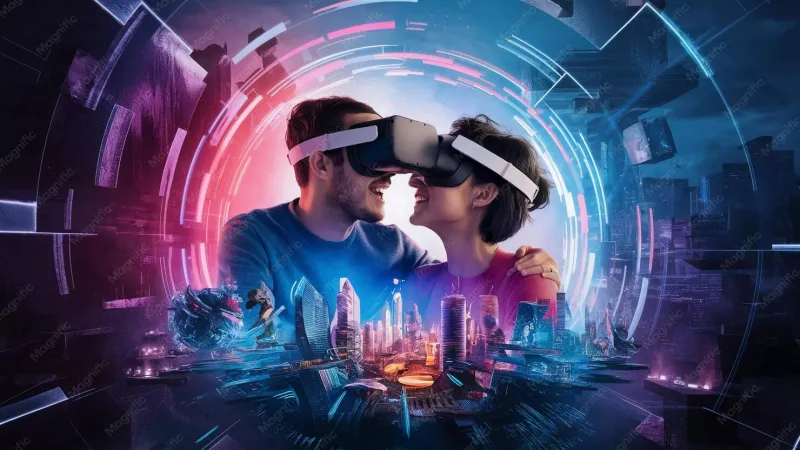
Photo: couple virtual reality avatars romantic digital world, via img.freepik.com
So you've spent three weeks meeting someone in a VR social space. You've explored digital art galleries together, laughed through a multiplayer escape room, and had a two-hour conversation floating above a pixelated ocean at sunset. Your heart genuinely races when their username pops up. Then you video call for the first time — same person, same voice, same sense of humor — and something just feels... off.
You're not alone. And no, you're not being shallow.
This is one of the quieter, weirder side effects of immersive social platforms: a psychological friction that nobody quite has a clean name for yet. Some researchers are calling it avatar attachment dissonance. Therapists are seeing it in their practices more and more. And the companies building VR dating and social apps? They're scrambling to figure out what to do about it.
Your Brain Doesn't Know It's a Game
Here's the thing about VR that makes it fundamentally different from texting or even video chat: your nervous system treats it as real. When you're standing next to someone's avatar in a convincingly rendered space, your brain is firing off social bonding signals the same way it would in a physical room. Eye contact — even simulated — triggers oxytocin responses. Shared experiences, even digital ones, build genuine emotional memory.
Dr. Jeremy Bailenson, founding director of Stanford's Virtual Human Interaction Lab, has spent years documenting this. His research shows that the brain's social cognition systems don't cleanly distinguish between avatar-mediated presence and in-person presence — especially in high-immersion environments. In other words, the feelings you develop in VR aren't fake. They're neurologically real.
But here's the catch: those feelings get anchored to a representation, not a person. And when the representation changes — or disappears entirely when you meet IRL — your brain gets confused in a very specific, uncomfortable way.
The Avatar Is Doing a Lot of Heavy Lifting
Most VR social platforms let users customize their avatars pretty extensively. Taller, shorter, different hair, different proportions, a completely different face. Some people build avatars that look roughly like them. Others go full fantasy — animal ears, glowing eyes, stylized cartoon aesthetics.
Even the people who try to be accurate are working with limited tools. A Meta Horizon avatar, a VRChat model, or a Rec Room character can capture vibe, maybe even personality — but it can't capture the thousand tiny physical details that human attraction actually runs on. The way someone moves their hands when they're nervous. The specific timbre of a laugh. The micro-expressions that flash across a face in under a second.
Relationship therapist Mara Solis, who practices in Austin and has started seeing clients specifically about digital relationship issues, puts it bluntly: "An avatar is basically a highlight reel with legs. People project onto it. They fill in the gaps with what they want to be there. And then they meet the actual human and feel like something got taken away from them — even though nothing was ever there to begin with."
That's a rough place to be emotionally. And it's becoming more common.
Parasocial Feelings, But Make It Mutual
Parasocial relationships — the one-sided emotional bonds people form with celebrities, streamers, or fictional characters — aren't new. But VR dating creates something stranger: a mutually parasocial dynamic. Both people are emotionally investing in versions of each other that are partly constructed, partly projected.
You're not just falling for their avatar. You're falling for the story your brain is writing about their avatar, based on the cues you're getting in an environment engineered to feel intimate and safe.
Platforms like VRChat, Nevermet, and newer entrants like Flirtual have leaned into this by building spaces specifically designed to foster emotional connection — low-stimulation environments, proximity mechanics that mimic real-world personal space, even haptic feedback on higher-end setups. All of that works. That's the point. But it also means the emotional stakes get raised before the real-world variables are ever introduced.
Companies Are Trying to Bridge the Gap — Sort Of
Some platforms are starting to address this head-on. Nevermet, which explicitly markets itself as a VR dating app, has added prompts encouraging users to video chat before meeting in person, trying to slowly layer in real-world presence before the full IRL leap. Others are experimenting with more realistic avatar generation — using phone camera scans to build avatars that more closely mirror actual appearance.
But there's a commercial tension here that nobody talks about openly: the fantasy version works better for engagement. People spend more time in platforms where they can present idealized versions of themselves. They come back more. They pay for more cosmetics and upgrades. A hyper-realistic avatar system that accurately captures every double chin and tired eye might be healthier for long-term relationship formation, but it's probably worse for the quarterly metrics.
Solis sees this playing out in her practice. "I've had clients who met in VR and genuinely fell in love — beautiful, lasting relationships. But I've also had people who are grieving what I can only describe as the death of someone who never existed. That's a real emotional loss, even if it sounds abstract."
So What Do You Actually Do With This?
None of this means VR dating is doomed or that you should swear off meeting people in immersive spaces. The connections being formed there are real, the experiences are meaningful, and for plenty of people — especially those in rural areas, with social anxiety, or in the disability community — VR social spaces offer access to connection that they genuinely couldn't find otherwise.
But going in with clear eyes matters. A few things worth keeping in mind:
- The feelings are real, the context isn't neutral. VR environments are designed to accelerate intimacy. That's not manipulation, but it is something to be aware of.
- Move toward video and voice sooner rather than later. The gap between avatar and person gets smaller the earlier you introduce unfiltered presence.
- Let yourself grieve the avatar if you need to. Seriously. If you meet someone IRL and the chemistry doesn't land, it's okay to acknowledge that something was lost — even if that something was partly a projection.
The metaverse is still figuring out how to be a place where humans actually connect. And humans are still figuring out how to connect in the metaverse. That gap — awkward, weird, occasionally heartbreaking — is exactly where the most interesting stuff is happening right now.