VR Without the Controller: 5 Wild Ways Immersive Tech Is Changing Everything Except Gaming

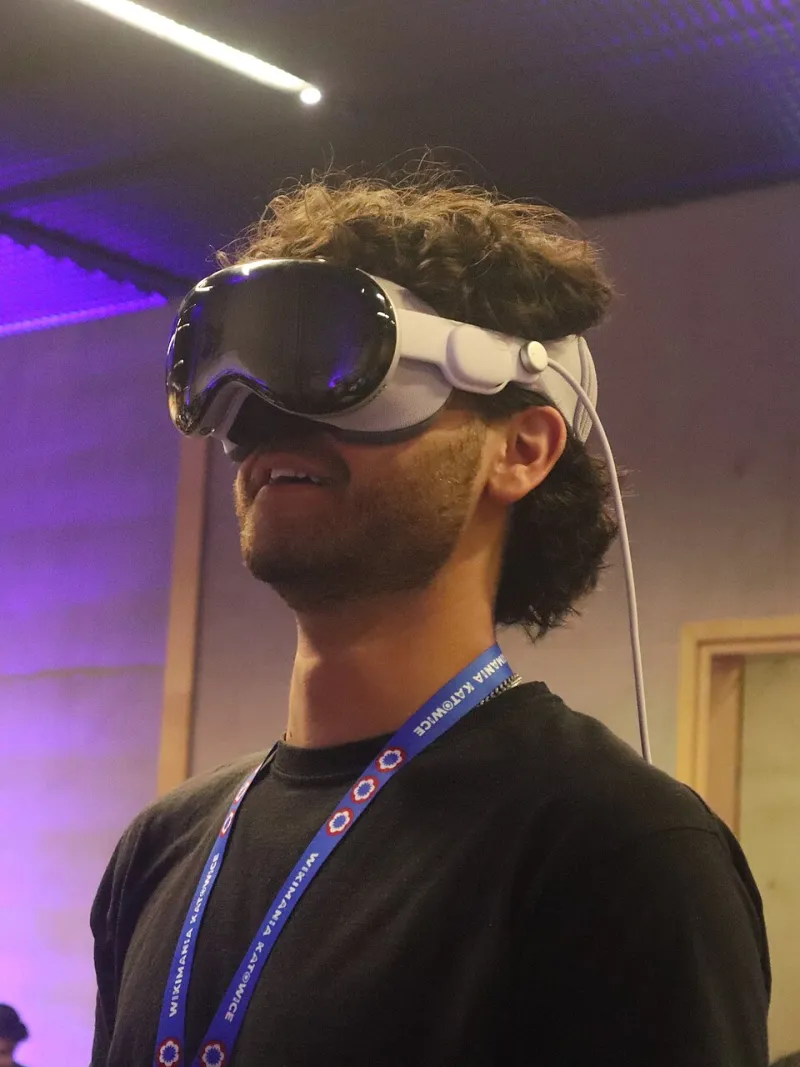
Photo: Judgefloro, CC0, via Wikimedia Commons
Let's be real — most people's mental image of VR still involves someone flailing around their living room trying to dodge virtual zombies. And look, that's a perfectly valid use of the technology. We're not here to judge. But if gaming is the only lens through which you're looking at virtual reality, you're missing a genuinely fascinating story about how immersive tech is creeping into corners of everyday American life that nobody predicted.
Here are five places VR is making moves that have nothing to do with your kill-death ratio.
1. Virtual Concerts That Hit Different Than a Screen
Streaming a live show on your laptop is fine. Watching it on a 65-inch TV is better. But neither of those comes close to what's happening when artists perform inside fully realized virtual environments built specifically for immersive audiences.
Platforms like Wave and AmazeVR have hosted virtual concerts for artists ranging from The Weeknd to Lindsey Stirling, and the experiences aren't just "360-degree video of a stage." They're purpose-built visual worlds where the performance and the environment are designed as a single piece of art. Fans can attend as customized avatars, interact with other concert-goers, and experience visual effects that would be physically impossible in a real venue.
For artists, it's also a genuinely compelling business model. No touring costs, no venue capacity limits, and the ability to reach fans in Omaha and Orlando simultaneously without anyone boarding a plane. Post-pandemic, a lot of musicians and their management teams started taking this seriously — and the production quality has followed.
For audiences, especially those who can't afford concert tickets in an era of Ticketmaster chaos, virtual shows offer something that feels surprisingly close to the real emotional experience of live music.
2. Immersive Theater That Puts You Inside the Story
Traditional theater asks you to sit down, stay quiet, and watch. Immersive theater has been pushing back against that for years — think Sleep No More in New York, where audiences wander through a massive multi-floor set and choose their own path through the narrative. Now VR is taking that concept somewhere theater buildings literally cannot go.
Productions like Wolves in the Walls (developed by Fable Studio, adapted from Neil Gaiman's work) put the viewer not just in the audience but inside the story as a character who the other characters actually acknowledge and respond to. You're not watching a little girl deal with monsters — you're her friend, and she talks to you directly.
Independent immersive theater companies across the US are starting to develop VR companion experiences, pre-show environments, and standalone virtual productions that don't require a physical venue at all. It's a format that's still being invented in real time, which makes it one of the more exciting creative spaces to watch right now.
3. Fitness Apps That Make You Forget You're Working Out
America has a complicated relationship with exercise. We know we should do it. We often don't enjoy doing it. And a lot of us are willing to pay for anything that makes it feel less like a chore.
Enter VR fitness, which has quietly become one of the more mainstream entry points for people who would never describe themselves as "VR users." Beat Saber — technically a rhythm game — became a legitimate workout tool with dedicated fitness tracking modes. Supernatural, a subscription-based VR fitness app, has built a devoted following by combining full-body workouts with stunning virtual landscapes and music licensing that would make most gym playlists jealous.
What makes this category interesting isn't just the novelty. Studies have consistently shown that VR exercise leads to longer workout sessions and lower perceived exertion — meaning people push harder without feeling like they're suffering as much. For a country where gym membership abandonment rates are notoriously high, that's not a trivial finding. Several health insurance providers have started exploring VR fitness subsidies, which tells you something about how seriously the wellness industry is taking this.
4. Virtual Travel and Cultural Experiences
Not everyone can afford to fly to Kyoto, walk through the Louvre, or stand at the rim of the Grand Canyon. Virtual reality isn't a perfect substitute for those experiences, and nobody's pretending it is. But it's becoming something genuinely valuable in its own right — a way to access places and moments that geography, cost, or physical ability might otherwise make impossible.
Google Arts & Culture's VR offerings let users explore museum collections and historical sites in remarkable detail. Apps like National Geographic Explore VR have put headset wearers on kayaks in Antarctica and at the peak of Machu Picchu. For educators, the implications are obvious — a history class that can virtually visit ancient Rome is a different kind of class entirely.
But it's not just education. There's a growing wellness angle here too. Researchers at institutions like the University of Southern California have been studying the therapeutic effects of virtual nature environments on stress, anxiety, and chronic pain. Hospital systems are starting to deploy VR nature experiences for patients who are bedridden or in palliative care. The results are quietly remarkable.
5. Social Hangouts That Are Actually Fun
This one gets the most skepticism, and honestly, some of it is deserved — early metaverse social platforms had some rough years aesthetically and functionally. But the social VR category has matured considerably, and for specific communities, it's become a genuinely central part of how people connect.
VRChat has evolved into a sprawling social ecosystem with dedicated communities around everything from anime to amateur improv comedy to language learning. Rec Room has carved out a family-friendly social gaming space with tens of millions of registered users. Horizon Worlds, Meta's own platform, has had a rocky road but continues to iterate.
What's interesting about social VR isn't the technology — it's the human behavior it enables. People who struggle with social anxiety report finding it easier to connect in virtual spaces. Long-distance couples and families use VR hangouts to share experiences in a way that feels more present than a video call. Niche communities that would never have critical mass in any single city find each other and build real friendships across virtual space.
None of this is replacing in-person human connection. But it's filling gaps that weren't being filled before, and for a lot of people, that matters quite a bit.
The gaming roots of VR aren't going anywhere — and they shouldn't. But the technology has clearly outgrown its original context. Whether you're a music fan, a fitness skeptic, a theater nerd, or just someone who wants to see what a coral reef looks like without getting on a plane, there's probably a VR experience that's relevant to your life right now. The headset is just the door. What's on the other side keeps getting more interesting.