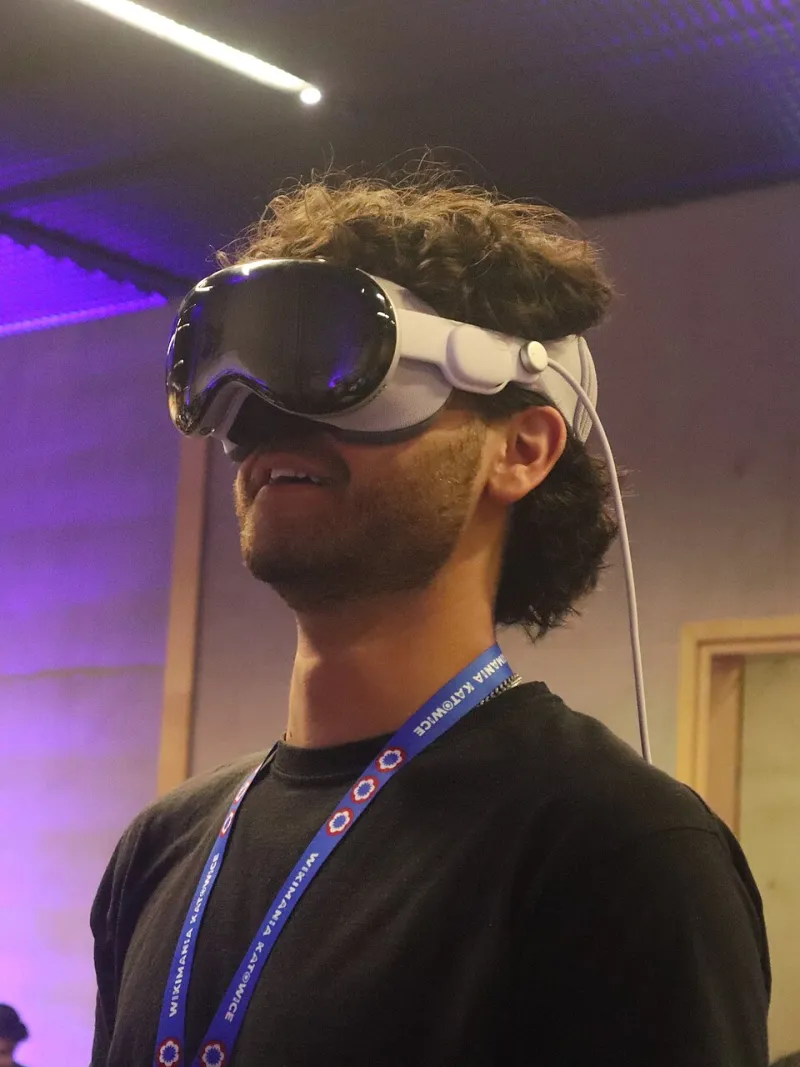
Mind Over Headset: How VR Hijacks Your Brain and Why You Keep Coming Back
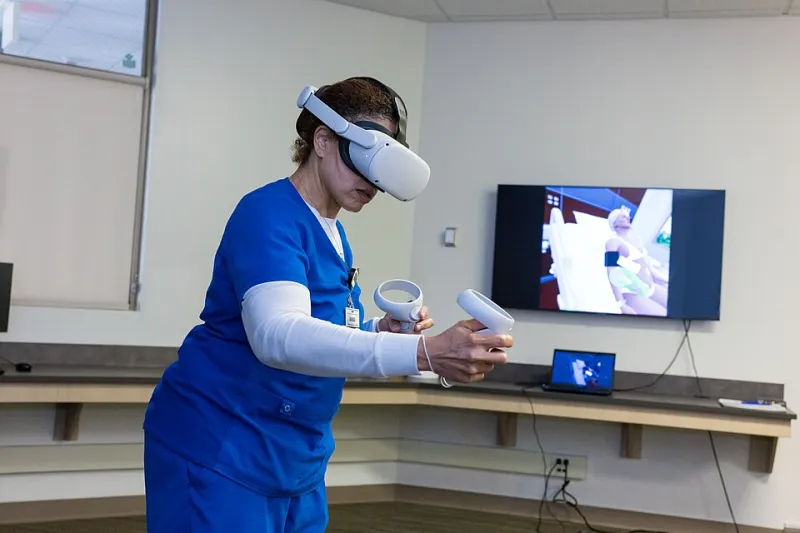
Photo: waketechcc, CC0, via Wikimedia Commons
Here's something wild to think about the next time you strap on a headset: your brain has no reliable way to tell the difference between a real cliff edge and a virtual one. Heart rate spikes. Palms sweat. Your body braces for impact. You know you're standing in your living room, but some ancient part of your nervous system just doesn't care. That gap between what you know and what you feel is the secret engine behind every great VR experience — and game designers have gotten very, very good at exploiting it.
What Neuroscientists Mean by 'Presence'
In VR research, the term "presence" refers to that subjective sensation of actually being somewhere — not watching it on a screen, not reading about it, but inhabiting it. It's distinct from immersion, which is more about the technical richness of a simulation. Presence is psychological. It's the moment your rational mind stops narrating the experience and just... lives it.
Neuroscientists trace a big chunk of this to the brain's predictive processing system. Basically, your brain is constantly running a model of the world around you, updating it with sensory data. When VR delivers the right combination of visual, auditory, and physical cues, your brain's model accepts the virtual environment as real — at least provisionally. The more consistent and coherent those cues are, the deeper the illusion holds.
Researchers at places like the Virtual Human Interaction Lab at Stanford have documented real physiological responses to virtual stimuli — stress hormones, empathy activation, even shifts in long-term behavior after VR experiences. This isn't placebo territory. The brain is genuinely being reshaped.
The Three Levers Designers Pull
So how do developers actually manufacture this feeling? It boils down to a few core techniques that have become the industry's standard toolkit.
Spatial Audio Is Doing More Work Than You Think
Most people credit visuals as the main driver of immersion, but audio engineers will tell you that spatial sound is quietly carrying a huge portion of the psychological load. When audio is mixed with proper head-related transfer functions (HRTFs) — essentially simulating how sound waves interact with the shape of your ears and skull — your brain places sounds in three-dimensional space with startling accuracy.
In practice, this means a virtual thunderstorm feels like it's rolling in from your left. A whispered voice feels inches from your ear. When the audio matches what your eyes are showing you, the brain's coherence check passes, and presence deepens. Break that sync even slightly, and the illusion starts to crack.
Haptic Feedback and the Body's Role in Belief
Touch is the sense VR has historically struggled with most, but modern haptic systems are closing the gap fast. Devices like the Meta Quest's controllers use rumble patterns to simulate texture and impact, but newer systems — including haptic gloves and full-body suits — can mimic the resistance of pushing through water or the subtle vibration of a surface underfoot.
Why does this matter so much? Because your sense of self in space — what researchers call proprioception — is intimately tied to physical sensation. When a virtual object pushes back against your hand in a way that feels right, your brain updates its body map to include that object as real. It's a small update, but it's a powerful one.
Frame Rate, Latency, and the Uncanny Valley of Motion
VR developers obsess over frame rates for a reason that goes beyond aesthetics. When the visual update rate drops below around 90 frames per second, your brain starts noticing a mismatch between your head movement and what your eyes are seeing. That mismatch triggers what's essentially a threat response — your vestibular system is getting one signal, your visual cortex another, and the result is disorientation, nausea, and a complete collapse of presence.
This is why even a modest dip in performance can ruin an otherwise excellent experience. It's not just uncomfortable; it's your nervous system flagging an inconsistency in reality. Designers spend enormous effort eliminating those inconsistencies.
Why Some Experiences Feel Addictive
Here's where it gets a little uncomfortable: the same psychological mechanisms that create presence can also create compulsive engagement. VR experiences that deliver consistent, high-quality presence tap into the brain's reward circuitry in ways that flat-screen media simply can't match.
Part of this is novelty — the brain lights up when it encounters something genuinely new, and truly convincing VR environments still qualify as novel for most people. But a bigger part is the sense of agency. When you can physically reach out and interact with a virtual world, the brain processes that as meaningful action in a way that clicking a mouse or pressing a button doesn't replicate. Agency feels good. It feels real.
Some developers lean into this deliberately. Social VR platforms, for instance, are designed around the fact that virtual eye contact and shared physical space trigger real social bonding responses. You're not just playing a game with someone — your brain is treating it like you're genuinely with them. That's a powerful hook, and the platforms that understand it are building experiences with serious staying power.
The Ethics of Engineering Presence
None of this is inherently sinister, but it does raise questions worth sitting with. If VR can generate genuine emotional responses, genuine stress, genuine attachment — at what point do designers have a responsibility to be transparent about what they're doing to your nervous system?
The VR industry is still pretty early in wrestling with this. Some developers are starting to build in friction — natural pause points, comfort settings, session timers — that give users more conscious control over their immersion. Others are leaning the other way, optimizing purely for engagement metrics.
As VR gets more sophisticated and more mainstream, the psychology of presence is going to become one of the defining conversations in tech ethics. For now, though, it's worth appreciating just how extraordinary it is that we've built machines capable of convincing the most complex object in the known universe — the human brain — that it's somewhere it isn't.
Next time you feel your pulse spike in a virtual haunted house, that's not a bug. That's the whole point.