Heard But Not Felt: The Audio Problem That's Quietly Killing VR Immersion
Put on a high-end headset today and the visuals will genuinely impress you. Textures are sharp, lighting reacts dynamically, and environments look detailed enough that your brain starts buying the illusion. Then a door creaks somewhere to your left, a character speaks two feet in front of you, or rain starts falling overhead — and something snaps. Not visually. Audibly. The world looks real and sounds like a YouTube video from 2011.
This is VR's audio problem, and it doesn't get nearly enough attention.
The Eyes Got All the Investment
For the past decade, the VR industry has funneled the overwhelming majority of its R&D dollars into display technology. Resolution, refresh rates, field of view, foveated rendering — the race to make virtual environments look photorealistic has been relentless and well-funded. And it's paid off. Modern headsets like the Meta Quest 3 and PlayStation VR2 can render scenes that genuinely trick your peripheral vision.
Audio? Not so much. The dirty truth is that spatial sound design has been treated as a secondary concern at nearly every major studio. Budgets reflect it. Timelines reflect it. The result is a persistent, nagging disconnect that audio engineers have a name for: the audiovisual mismatch. You see a cave, but you hear a bathroom. You watch a crowd, but the voices feel like they're coming from a flat screen behind your face.
It's the VR equivalent of watching a foreign film where the dubbing is always just slightly off. Your brain notices. It never fully stops noticing.
Why Spatial Audio Is Harder Than It Looks (Or Sounds)
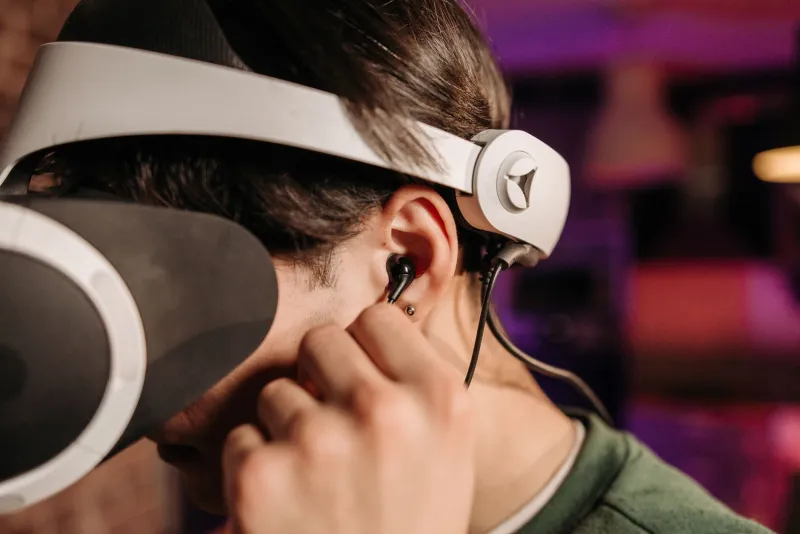
Here's the thing about human hearing — it's extraordinarily sophisticated in ways that are genuinely difficult to replicate. When you hear a sound in the real world, your brain processes dozens of micro-cues simultaneously: the tiny delay between when sound hits your left ear versus your right, how the shape of your outer ear (your pinna) filters certain frequencies, the way sound bounces differently off carpet versus concrete, how a noise behind you sounds different from one in front of you even at the same volume.
Replicating all of that in real time, for a moving player in a dynamic virtual environment, is a genuinely hard engineering problem. The technical term for the personalized audio fingerprint your ears create is an HRTF — Head-Related Transfer Function. Every person's HRTF is slightly different based on their ear shape, head size, and even shoulder width. Generic HRTFs, which is what most VR games use, feel close enough in a demo but fall apart over hours of play.
Add room acoustics into the mix and the complexity multiplies fast. Real spaces have reverb signatures. A gunshot in a cathedral sounds nothing like a gunshot in a parking garage, and your brain knows the difference instantly. Simulating that dynamically — as players move through environments, open doors, step from stone floors onto grass — requires serious computational overhead that most development pipelines simply haven't prioritized.
AAA Studios Are Mostly Phoning It In
Let's be honest about the big players here. Several high-profile VR titles have shipped in recent years with audio that ranges from "fine" to genuinely embarrassing. Positional sound that doesn't track correctly when you tilt your head. Ambient soundscapes that loop so obviously you start counting the repetitions. Dialogue that sounds like it was recorded in a studio and dropped into a virtual space without any environmental processing.
The excuse from larger studios often boils down to resources and time. Audio gets finished last, which means it gets rushed most. When a project is running over schedule and over budget, the sound team absorbs the cuts. Players complain about it in reviews, the studio patches what it can, and the cycle repeats with the next title.
There's also a hardware gap. Not all headsets handle spatial audio the same way. Developing audio that works well across the Meta ecosystem, SteamVR, and PlayStation VR2 simultaneously means compromising somewhere. The path of least resistance is usually a stereo-ish mix with some basic positional cues — which is exactly as underwhelming as it sounds.
The Indie Studios Getting It Right
Here's where the story gets more interesting. A handful of smaller studios have decided that audio is actually their competitive edge, and the results are striking.
Studios like Valve (not indie in the traditional sense, but small by AAA standards) set a high bar with Half-Life: Alyx, which remains one of the most aurally convincing VR experiences ever shipped. Every surface had a distinct acoustic character. Sound cues gave you genuine spatial information. Players reported instinctively ducking away from audio-signaled threats — which is exactly the kind of embodied response good spatial audio is supposed to trigger.
Smaller indie developers working in the horror and exploration genres have also pushed the envelope, partly because their gameplay depends on it. When your entire tension loop relies on audio cues — a shuffle in the next room, a breath that's too close — you invest in getting the sound right. Several of these teams have started building custom HRTF calibration tools directly into their games, letting players adjust audio profiles to better match their own hearing geometry. It's a small touch that makes a massive difference.
There's also growing momentum around Ambisonics, a spatial audio format that encodes sound in a full 360-degree sphere rather than a traditional stereo or surround setup. When implemented well, Ambisonic audio moves with you as you rotate your head, maintaining accurate directionality in a way that standard mixes simply can't match. More indie titles are adopting it. Most AAA pipelines still haven't fully integrated it.
What Needs to Change
The path forward isn't mysterious — it's just expensive and time-consuming. Studios need to budget for audio with the same seriousness they budget for rendering. Sound designers need to be in the room during environment design, not handed a completed level and told to make it sound good. HRTF personalization needs to become a standard feature, not a novelty.
On the hardware side, headset manufacturers could do more. Built-in microphones that measure a user's ear acoustics at setup — similar to how some high-end home theater systems calibrate to your room — would give developers better data to work with. The technology exists. It's mostly a question of whether anyone decides it's worth the added complexity.
Players can push this too. If audio quality shows up consistently in reviews, in forum complaints, in refund requests — studios will eventually respond. The graphics arms race happened because consumers demanded better visuals and the market rewarded studios that delivered them. Audio deserves the same pressure.
Your Ears Know When Something's Wrong
The reason this matters isn't purely technical. Immersion in VR is fundamentally about convincing your nervous system that you're somewhere you're not. Visuals get you most of the way there. But audio is the difference between looking at a virtual world and actually being inside one.
Right now, most VR experiences are asking you to live with a fundamental contradiction: environments that look three-dimensional and sound flat. Your brain tolerates it, adapts to it even — but it never fully surrenders to the illusion. That low-level cognitive friction is part of why some players feel fatigued after long sessions, why presence can be hard to maintain, why something always feels slightly off even in the best-looking titles.
Fix the audio, and you fix immersion in a way no graphics upgrade can match. The headsets are ready. The question is whether the industry is willing to actually listen.