1,000 Hours In, and Now Real Life Feels Broken: The Hidden Social Cost of Heavy VR Use

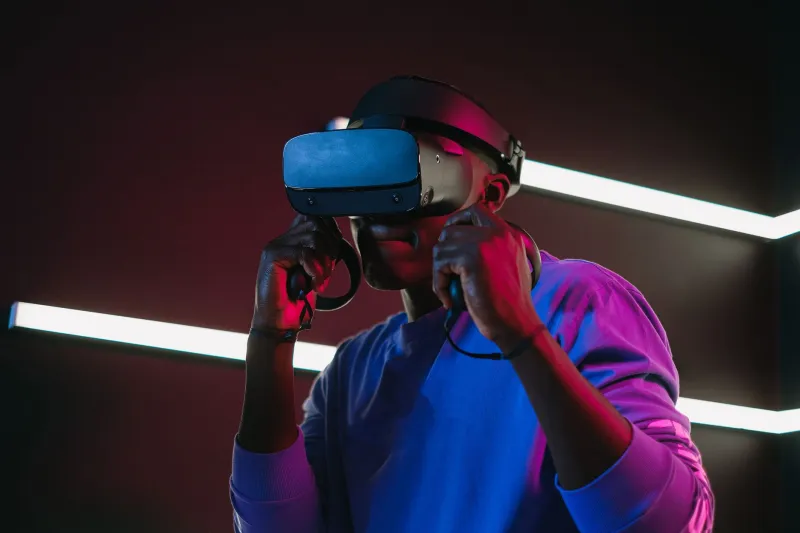
Photo by Photo by Vitaly Gariev on Unsplash on Unsplash
Marco, a 29-year-old software engineer from Austin, Texas, didn't notice anything was off until a coworker pulled him aside after a team lunch. "She told me I kept looking past people when they talked to me," he says. "Like I was scanning the room for something. I didn't even realize I was doing it."
Marco logs somewhere between 15 and 20 hours a week in VR — social platforms, multiplayer games, a couple of fitness apps. By most metrics, he's a power user. And increasingly, people like him are reporting something strange: the longer they spend inside the headset, the weirder the real world starts to feel.
It sounds like the premise of a Black Mirror episode. But therapists and neuroscientists are paying closer attention to what's actually happening when someone spends a cumulative thousand-plus hours in a virtual environment — and then tries to go have a normal conversation at a barbecue.
Your Brain Doesn't Know the Difference (Until It Does)
Here's the uncomfortable truth about immersive VR: your brain is genuinely, measurably affected by it. Dr. Priya Nair, a cognitive neuroscientist based in San Francisco who studies sensory adaptation, explains it this way: "The brain is a prediction machine. It constantly models the world based on what it expects to encounter. When you spend significant time in an environment with different rules — different eye contact norms, different physical feedback, different spatial cues — you're essentially retraining those prediction models."
In virtual spaces, the social rules are subtly different. Eye contact in VR is often handled by avatars that don't blink naturally or track gaze the way humans do. Personal space is elastic — you can float through someone or stand uncomfortably close without the normal physiological discomfort that would occur in person. Facial micro-expressions, the tiny involuntary flickers that humans rely on to read emotion, are either absent or heavily stylized.
When you log off and step into a grocery store or a first date, your brain is still running some of those recalibrated expectations. For most people, it's a minor, temporary glitch. For heavy users, it can linger in ways that are genuinely disruptive.
What Heavy Users Are Actually Experiencing
Across VR communities on Reddit, Discord, and platforms like VRChat, a recurring thread has emerged over the past couple of years: users describing a growing sense of flatness or friction in offline social interactions. Some call it "the hangover." Others describe it as feeling like an NPC in their own life.
Jessica, a 34-year-old from Chicago who uses VR primarily for social connection, describes it plainly: "I started noticing I'd get home from a party and feel like I'd performed rather than participated. Like I was playing a character of myself but without the interface telling me what to do next."
That language — performance, interface, feedback — keeps coming up. And it makes a certain kind of sense. Social VR platforms provide a lot of implicit scaffolding that real life doesn't: proximity indicators, name tags floating above heads, clear audio channels, the ability to mute or exit a conversation without consequence. Real conversations don't come with a mute button.
Licensed therapist Dana Okafor, who practices in Atlanta and has begun seeing clients specifically around technology-related social anxiety, says she's noticed a pattern. "A number of my clients who are heavy VR users describe something similar to what people experience after long periods of remote work or social isolation — a kind of social rustiness. But with VR, there's an added layer because the virtual social environment is so stimulating and so controllable. Real-world interaction, by comparison, can feel chaotic and unrewarding."
The Eye Contact Problem
One of the most commonly reported issues is eye contact — specifically, the difficulty of sustaining it in person. In VR, gaze is often a non-issue; your avatar looks where you point it, and most platforms don't replicate the subtle discomfort of prolonged eye contact. In real life, eye contact is a deeply loaded social signal, and calibrating it correctly is something humans learn over years of in-person interaction.
Marco, from Austin, says this is exactly what his coworker noticed. "In VR, you're kind of always looking at the environment, scanning for interaction points. I think I brought that habit into the real world without knowing it."
Dr. Nair isn't surprised. "Gaze behavior is highly trainable. Athletes train it, performers train it. If you're spending significant hours in an environment that doesn't reinforce normal gaze patterns, you may find your defaults shift."
It's Not All Doom and Gloom — But Don't Ignore It Either
Before you throw your headset out the window: this isn't a universal experience, and it doesn't mean VR is frying your social brain. For many users, VR has actually expanded social confidence — particularly for people with social anxiety who use virtual spaces to practice interaction in lower-stakes environments. Research out of Oxford and USC has shown VR-based social training can have real, positive carryover into physical interactions.
The issue seems to be more about balance and awareness than a blanket indictment of immersive tech. Okafor puts it directly: "The problem isn't VR. The problem is when VR becomes the primary or preferred mode of social interaction for extended periods, without intentional effort to maintain real-world social engagement."
Practical Ways to Keep Your Social Wiring Intact
If you're logging serious hours in the headset and starting to notice some friction in your offline life, here are some approaches therapists and researchers suggest:
Schedule offline social time like you schedule sessions. Treat in-person hangouts with the same intentionality you bring to a VR meetup. Put it on the calendar. Show up.
Do a "re-entry" ritual. Some heavy users find it helpful to take five to ten minutes after a long session before engaging with other people — a walk outside, some deep breathing, anything that helps your brain shift gears from virtual to physical context.
Practice analog eye contact. It sounds almost absurdly simple, but deliberately practicing sustained, natural eye contact in low-pressure situations (with friends, family, a barista) can help recalibrate those defaults faster than you'd expect.
Mix your social diet. If most of your meaningful social interaction is happening in VR, that's a signal worth paying attention to. Not a judgment — just data.
Talk to someone if it's affecting your life. If you're genuinely struggling with offline social function, a therapist who understands technology use (they're increasingly easy to find) can help you work through it without making you feel like a weirdo for owning a headset.
The Bigger Picture
VR is still young. The first generation of truly heavy, long-term users is only now hitting the multi-year mark, which means we're just starting to understand what a lifetime of immersive tech use actually looks like. The research is early, the anecdotes are accumulating, and the honest answer is: we don't fully know yet.
What we do know is that the brain is plastic — it adapts to what you feed it. If you're feeding it thousands of hours of virtual social environments, it will adapt accordingly. That's not inherently bad. It just means you have to be intentional about what else you're feeding it.
The metaverse isn't going anywhere. But neither is the physical world — awkward eye contact and all.