You Spent Two Grand on a Headset. So Where Are All the Games?
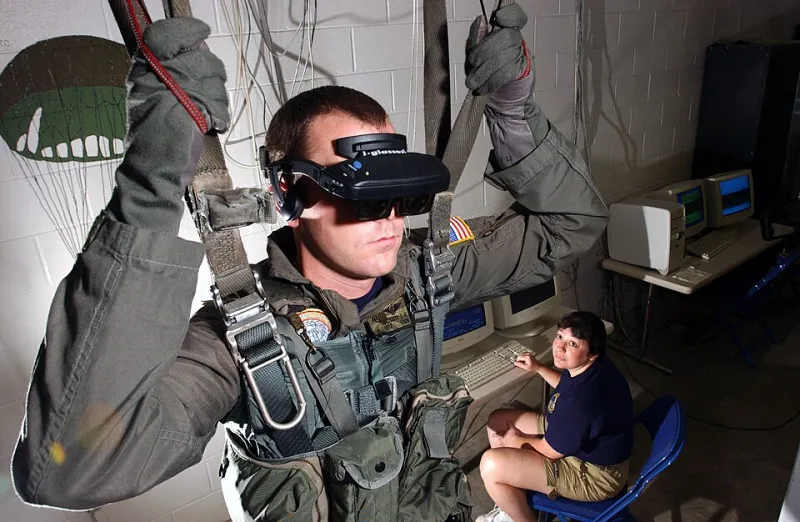
Photo: Unknown, Public domain, via Wikimedia Commons
Let's be honest about something that doesn't get said enough in the VR space: dropping serious money on a premium headset and then hunting for something genuinely new to play is a uniquely frustrating experience. You've got this sleek piece of technology sitting on your face, capable of rendering entire worlds, and yet somehow you're replaying the same wave shooter you finished eighteen months ago.
This isn't a you problem. It's a structural one — and it runs deep.
The Math That's Killing VR Game Development
Building a full-length, polished VR title is expensive. Not "mobile game expensive" — we're talking budgets that can rival mid-tier console productions, sometimes pushing into the $5 to $20 million range when you factor in spatial audio design, motion capture adapted for first-person perspectives, and the sheer engineering overhead of making an experience that doesn't make players physically ill.
Now stack that against the addressable market. Even with recent hardware sales momentum, the total number of active VR headset users in the US is a fraction of the install base for a single major console generation. A PlayStation 5 title that sells a million copies is considered a modest performer. A VR exclusive that moves 300,000 units? That's practically a blockbuster in this space.
The math just doesn't work for most major publishers. When a studio has to choose between funding a VR exclusive or greenlighting the next entry in a proven franchise that will sell to tens of millions of players, the spreadsheet makes the decision for them every single time.
Why the Big Studios Keep Sitting This Out
The hesitation from major publishers isn't laziness or ignorance — it's risk management. EA, Activision, Take-Two: these companies have shareholders to answer to and quarterly targets to hit. VR remains a market where even high-profile experiments have struggled to justify their investment.
Remember when Resident Evil 7 got a full PlayStation VR version and people lost their minds over how terrifying it was? That was 2017. Nearly a decade later, we're still waiting for that moment to spark a wave of AAA VR commitments that never quite materialized. The studios noticed. They saw the critical praise, shrugged at the sales figures, and went back to making games for the platforms where the money actually lives.
Some companies have made genuine investments — Sony's first-party support for PlayStation VR2 has been more consistent than most, and Meta has poured money into exclusive content for Quest. But even those efforts feel thin when you're measuring them against the depth of content available on traditional platforms. A few tentpole titles a year isn't a library. It's a waiting room.
The Indie Layer: Talented, Scrappy, and Spread Too Thin
The gap left by major studios hasn't gone unfilled — it's just been filled by a different kind of developer. The VR indie scene is genuinely impressive, packed with small teams doing creative things that bigger studios would never greenlight. Games like Lone Echo, I Expect You To Die, and Pistol Whip came from studios that weren't household names, built by developers who actually believed in the medium.
But indie studios face their own version of the same math problem. They're working with smaller budgets, smaller teams, and shorter runways. When a VR title underperforms — even slightly — it can end a studio entirely. There's no back catalog of hits to absorb the loss. That financial fragility means fewer risks, shorter experiences, and a content pipeline that can feel more like a trickle than a stream.
What the indie scene does well, it does brilliantly. What it can't do is replace the volume and variety that a healthy platform ecosystem needs to keep players engaged long-term.
The Vicious Cycle Nobody Wants to Talk About
Here's the part that's genuinely uncomfortable to sit with: the content drought and the small player base are feeding each other.
Consumers look at the available library, decide it doesn't justify the hardware cost, and hold off on buying. Developers look at the small install base, decide it doesn't justify a major investment, and hold off on building. Hardware manufacturers watch both groups hesitate and struggle to make the case for their next device.
Breaking this cycle requires someone to blink first — to invest ahead of the audience rather than waiting for the audience to show up. That's happened in gaming before. The early PlayStation 2 library was thin. The Xbox 360 launched with a handful of titles. Platforms survive their awkward early years when the hardware momentum is strong enough to pull developers along.
VR has been in its "awkward early years" for about a decade now, which is starting to strain that comparison.
What Should You Actually Expect From Your Investment?
If you've already bought into premium VR hardware — or you're seriously considering it — here's a realistic framing that might save you some frustration.
Think of your headset less like a gaming console and more like a platform with a strong catalog of existing experiences and a slow drip of new ones. The titles that are already out? Many of them are legitimately great. Half-Life: Alyx remains one of the most technically accomplished games ever made in any format. Beat Saber has more replay value than most full-price releases. The VR fitness space has quietly built out a solid selection of content.
But if you're expecting a steady flow of new releases comparable to what you'd get on a PS5 or Xbox Series X, you're going to be disappointed. That's not a knock on the technology — it's an honest read of where the market actually is.
The content situation is improving, slowly. More developers are experimenting with hybrid releases that include VR modes alongside traditional gameplay. Mixed reality features on newer headsets are opening up design possibilities that might attract studios who were previously skeptical. And there's a real argument that AI-assisted development tools could eventually lower the cost of building VR content enough to change the economics.
The Headset Isn't the Problem
The hardware has genuinely gotten good. Display resolution, tracking accuracy, controller ergonomics — the technical side of premium VR is at a point where it's no longer the limiting factor in the experience.
The limiting factor is content, and the limiting factor behind that is economics, and the limiting factor behind that is the size of the audience. Until one of those dominoes falls in a significant way, premium VR will keep feeling like a spectacular television with three channels.
That's a frustrating place to be as a consumer. But it's also worth remembering that every platform worth having has had a version of this problem. The question is whether VR's moment of genuine critical mass is still ahead — or whether it's been perpetually five years away for long enough that we should stop counting.