VR Streaming's Dirty Little Secret: The Gap Between Playing and Watching
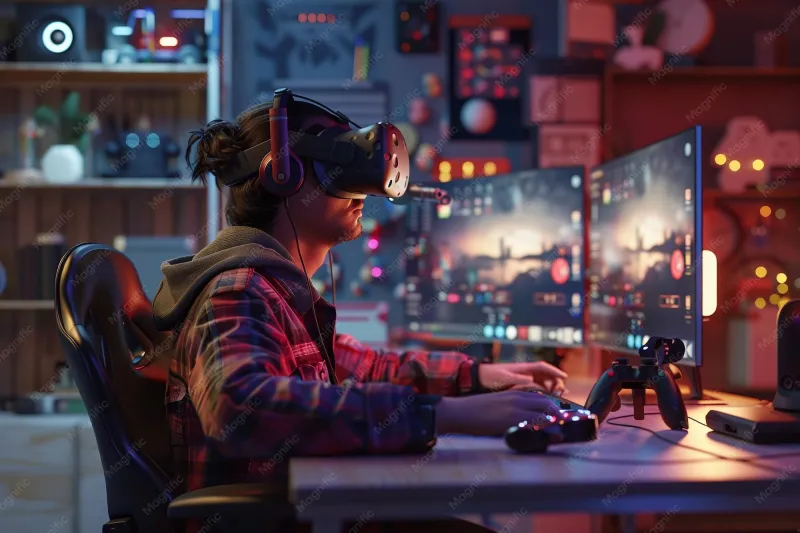
Photo: streamer wearing VR headset gaming setup with camera and monitors, via img.freepik.com
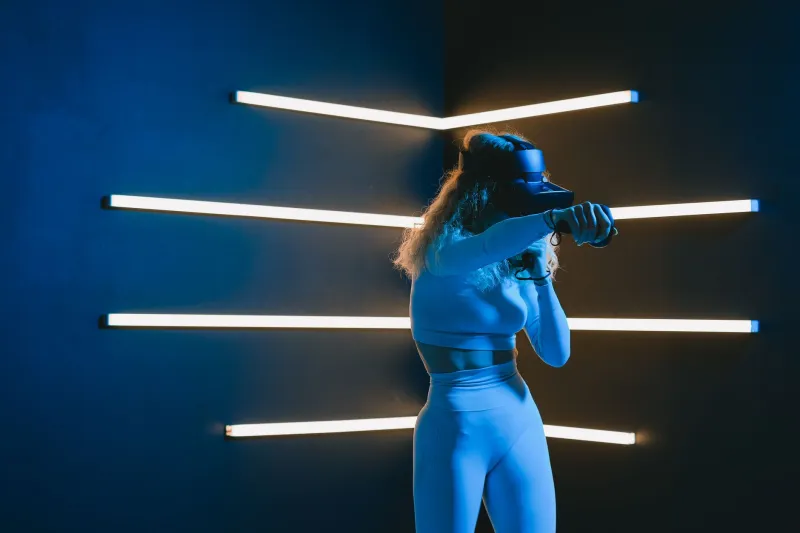
Picture this: you're deep in a VR escape room, heart pounding, physically ducking under laser beams, reaching out to grab a puzzle piece that your hands can actually feel the weight of. It's electric. It's one of the best gaming experiences you've had in years. You clip it and post it to your stream.
Your viewers watch a slightly wobbly first-person camera pan around a room, occasionally interrupted by two floating hands picking things up. Chat goes quiet. Someone types "cool I guess."
This is the VR streaming problem, and it's bigger than most people in the industry want to admit.
The Immersion Paradox
Here's the core tension: VR is powerful precisely because it puts you inside the experience. The first-person perspective, the physical engagement, the sense of presence — those are the whole point. But streaming, as a medium, has evolved around something fundamentally different: watching someone else's reactions, following a narrative camera, and experiencing a game as a kind of collaborative spectator sport.
When you watch a streamer play a traditional game, you're essentially watching a movie with commentary. The camera is designed for an audience. The game world is framed for visual storytelling. A skilled streamer can use that to build tension, humor, and connection.
VR collapses that structure entirely. The "camera" is the player's head. The framing is whatever they happen to be looking at. The physical comedy of someone flailing their arms in real life isn't captured by the headset's perspective — it's happening in a dimension the stream can't see. What makes VR thrilling to play is almost perfectly inverse to what makes content engaging to watch.
The Numbers Don't Lie
The streaming data tells a pretty clear story. VR content consistently underperforms on Twitch and YouTube compared to traditional gaming content, even when the underlying game is critically acclaimed. Titles like Half-Life: Alyx — widely considered one of the greatest games ever made — generated a fraction of the streaming viewership of comparably hyped flat-screen releases.
Creators who've tried to build VR-focused channels report a brutal discovery curve. "You go in thinking the novelty will carry it," one mid-size VR content creator noted in a community discussion earlier this year, "and then you realize that novelty only works if the viewer can feel the novelty. They can't. They're just watching a slightly weird FPS."
The average viewer retention on VR streams tends to drop significantly after the first few minutes, once the initial curiosity fades and the visual limitations of first-person VR footage become apparent. Without a strong personality or gimmick layered on top, the content struggles to hold attention.
Why This Is Actually an Industry Problem
For anyone working in VR development or content strategy, this matters way beyond individual streamers' view counts. Streaming has become one of the most powerful marketing channels in gaming. Organic streaming buzz drove massive sales for games like Among Us, Valheim, and Lethal Company — titles that spread because watching them was almost as fun as playing them.
VR doesn't have that flywheel. A great VR game can't go viral through streaming the way a great flat-screen game can, which means the discovery pipeline is fundamentally broken. Players who might love VR never find out about the best experiences because those experiences don't translate into compelling viewing content. The industry ends up preaching to the converted.
This creates a compounding problem for studios trying to justify VR development budgets. Without streaming visibility, player acquisition costs stay high. Without player acquisition, the install base stays small. Without a large install base, investors stay skeptical. The VR streaming problem isn't just a content issue — it's a growth ceiling.
The Solutions People Are Actually Building
The good news is that smart people are working on this, and some of the approaches are genuinely interesting.
Spectator modes are the most straightforward fix, and more VR titles are shipping with dedicated third-person camera systems that give streamers a cinematic view of the action. Games like Pistol Whip and Beat Saber benefit enormously from this — watching someone crush a rhythm game from a third-person angle is actually exciting. The player's full-body movement becomes part of the entertainment. Studios that invest in spectator tooling are seeing measurably better streaming performance.
Mixed reality capture takes this further, compositing the player's real-world body into the virtual environment. The result looks like a green-screen production where you can see the actual human being inside the game world. It's technically demanding and requires a decent camera setup, but the content it produces is dramatically more watchable than raw headset footage. As the tooling gets cheaper and more accessible, this is likely to become standard practice for serious VR creators.
AI-enhanced broadcasting is an emerging frontier that a few startups are exploring. The concept involves using AI to dynamically reframe VR footage — essentially adding an intelligent camera director that makes real-time decisions about framing, cutting, and perspective to create broadcast-quality output from raw headset data. It's early, but the demos are promising.
VR-native streaming platforms represent a more radical rethink. Rather than adapting VR content for flat-screen audiences, why not build streaming experiences designed to be watched inside VR? Platforms like VRChat and Rec Room already host live events where audiences watch performances inside virtual spaces. The viewer isn't passively watching a stream — they're present in a shared virtual environment. That fundamentally changes the engagement dynamic.
The Personality Problem Isn't Going Away
Technology solutions help, but they don't solve everything. Part of what makes traditional streaming work is the streamer's face. Reactions, expressions, the human moment of genuine surprise or frustration — these are the emotional glue of streaming content. In VR, the streamer's face is hidden behind a headset. You lose the most expressive part of the performance.
Some creators are experimenting with face-tracking overlays and avatar systems that capture and display emotional data in real time. Others just mount a face camera below the headset, accepting the slightly absurd aesthetic in exchange for keeping that human connection. Neither solution is perfect, but both are better than nothing.
The streamers who are genuinely cracking VR content tend to be the ones who've leaned into the physicality — the over-the-top reactions, the full-body comedy, the willingness to look ridiculous. The best VR streaming content right now is essentially physical comedy theater. That's a niche, but it's a real one.
What Has to Change
The VR streaming problem is ultimately a design problem, not just a technology problem. It requires game developers to think about spectators as a first-class audience from day one, not as an afterthought. It requires platform investment in tools that make mixed reality capture accessible to creators without Hollywood budgets. And it requires a broader shift in how audiences think about watching versus experiencing.
The flat-screen streaming model took years to mature. VR is still figuring out its equivalent of the "let's play" format — the viewing paradigm that makes watching as valuable as playing. That format probably exists. Someone is going to crack it.
When they do, the content that follows is going to be unlike anything streaming has seen before. The gap between immersion and entertainment is real, but it's also closeable. And whoever closes it is going to own the next era of gaming entertainment.